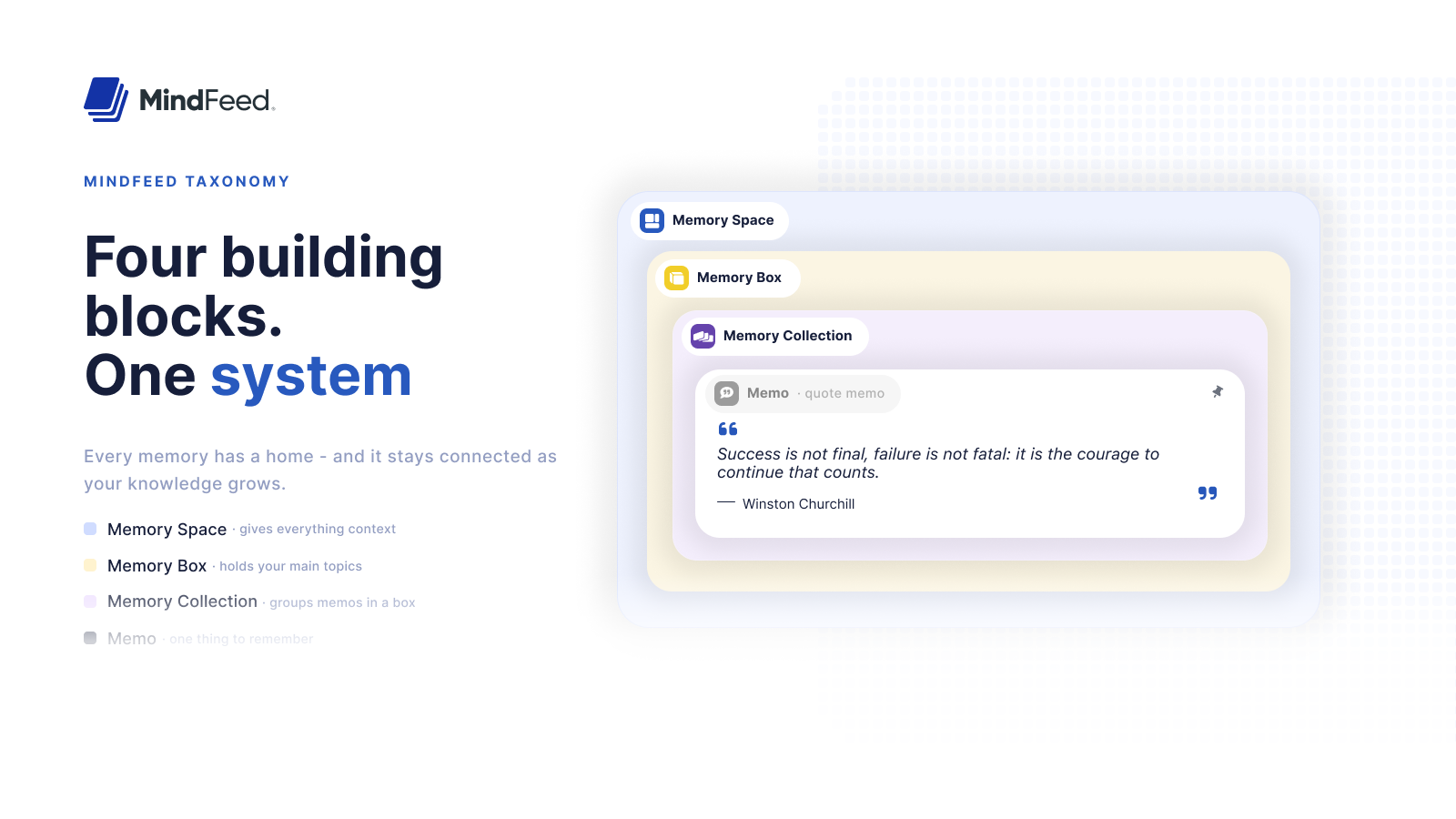
When people first open MindFeed, one of the first things they notice is that there are four different building blocks:
- Memory Spaces
- Memory Boxes
- Memory Collections
- Memos
At first glance, it might seem like a lot.
In reality, they're just four different ways of giving your memories a place to belong.
Each one has a purpose, and together they create a structure that feels natural whether you've saved ten memories or ten thousand.
It all starts with a Memo
Every piece of knowledge begins as a Memo.
A quick idea. A photo. A PDF. A webpage. A voice recording. A meeting note.
A Memo is simply one thing you want to remember.
It's the smallest piece of your knowledge, but it's also the most important. Every insight, every project, and every idea starts here.
Memory Spaces give everything context
A Memory Space is the broadest layer in MindFeed.
It's the place where a whole area of your knowledge lives. That might be personal memories, work, a team space, a client, a project, or anything else you want to keep in its own context.
A Space helps everything inside it feel connected.
Memory Boxes hold your main topics
Inside a Memory Space, you create Memory Boxes.
A Box is where a meaningful topic, project, or area of interest begins to take shape.
It might hold research for a launch, notes from a course, memories from a trip, or ideas for something you're building.
This is where your Memos stop feeling like scattered pieces and start becoming something you can return to.
Memory Collections organise what is inside a Box
As a Memory Box grows, you may want a little more shape inside it.
That's what Memory Collections are for.
Collections live within a Memory Box and help group related Memos inside that Box.
For example, a product launch Box might contain Collections for customer research, positioning ideas, design inspiration, and launch notes.
The Box gives the topic a home. Collections make that home easier to explore.
Knowledge should grow, not sprawl
One of the things we love most about this structure is that it grows alongside you.
You can begin with a single Memo. As more memories appear, they can gather inside a Memory Box. As that Box grows, Collections can help bring order to what is inside it. And the whole thing stays grounded inside the right Memory Space.
The relationships are clear:
Memory Space → Memory Box → Memory Collection → Memo
That's the real value of MindFeed's taxonomy.
It gives every memory a place within a system that continues to make sense as your knowledge grows.
In short: Spaces give context, Boxes hold topics, Collections organise what is inside each Box, and Memos are the memories that bring everything to life.